
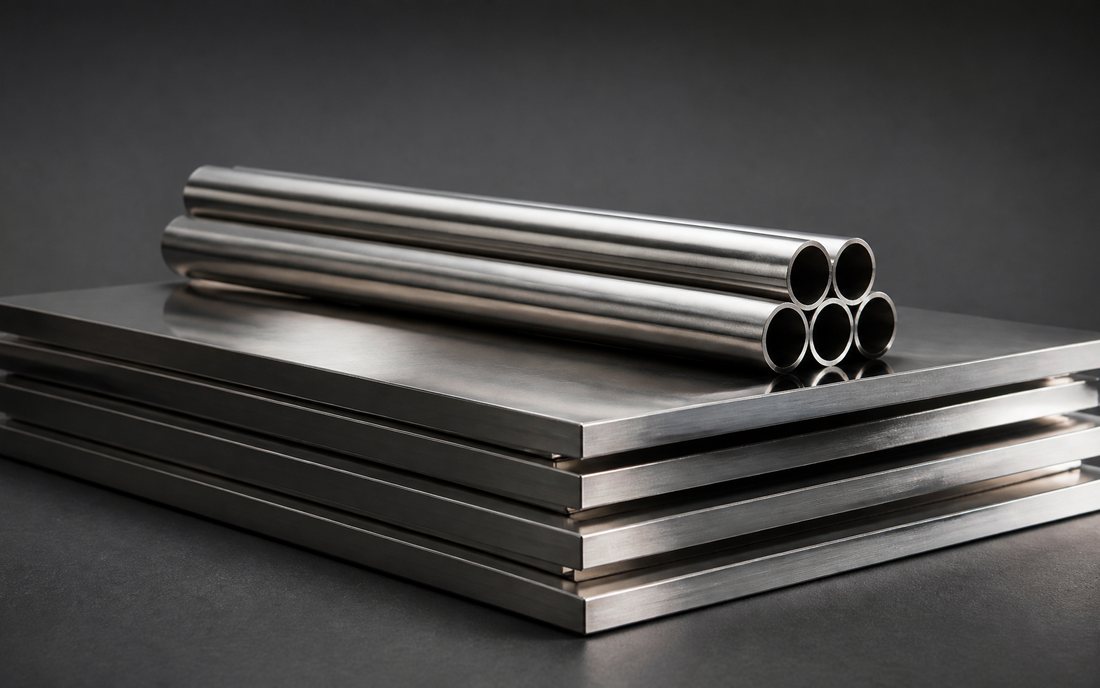
310
310 (UNS S31000) is a high-chromium-nickel austenitic stainless steel, distinguished by its higher carbon content compared to 310S. It is renowned for excellent high-temperature strength, outstanding oxidation resistance, and good corrosion resistance. It maintains stable mechanical properties during long-term service at high temperatures (up to 1200 °C) and has strong thermal load-bearing capacity, making it a preferred material for high-temperature structural components under moderate corrosion conditions..
- UNS
- S31000
- Density
- 7.98 g/cm³
- Melting range
- 1398 – 1454 °C
- Delivery
- Annealed and pickled, or cold-rolled bright; cut to length.
What the spec says
Chemical composition in weight per cent and the standards we routinely certify to. Governing values are those printed on the EN 10204 certificate for your heat.
| Element | % |
|---|---|
| C | ≤ 0.25 |
| Cr | 24.0 - 26.0 |
| Ni | 19.0 - 22.0 |
| Si | ≤ 1.50 |
| Mn | ≤ 2.00 |
| P | ≤ 0.045 |
| S | ≤ 0.030 |
| Fe | Balance |
| Form | Standard |
|---|---|
| Round Bars | ASTM A276, GB/T 1220, DIN 17440 |
| Forgings | ASTM A182/A182M, GB/T 1221, DIN 17482 |
Behaviour that matters in service
- High-Temperature Strength & Oxidation Resistance. — Excels in oxidation resistance in air at temperatures up to 1200 °C (higher than 310S’s typical 1150 °C). The higher carbon content enhances high-temperature tensile strength and creep resistance, while the dense chromium oxide film on the surface prevents further oxidation—suitable for load-bearing high-temperature components..
- Corrosion Resistance — Demonstrates strong resistance to oxidizing acids (e.g., nitric acid) and high-temperature gases. However, due to higher carbon content, its resistance to intergranular corrosion is inferior to 310S; post-weld annealing is recommended for applications in corrosive high-temperature environments..
- Thermal Stability — Retains excellent mechanical properties under long-term high-temperature exposure (1000 – 1200 °C) and resists thermal fatigue deformation, ensuring structural stability of heavy-duty high-temperature parts..
- Formability & Processability — Can be processed via cold working (e.g., rolling, stamping) and hot working (e.g., forging, extrusion). Hot working performance is superior due to higher carbon content, facilitating fabrication of thick-walled or heavy structural components..
- Weldability — Compatible with common welding methods (e.g., TIG welding, MIG welding). To avoid intergranular corrosion, low-carbon filler metals (e.g., ER310L) are recommended, and post-weld heat treatment (solution annealing at 1050 – 1150 °C) is advised for corrosive service..
Typical applications
- Thermal Processing Industry — Widely used in heavy-duty industrial furnace components (e.g., load-bearing furnace frames, thick-walled furnace tubes, high-temperature furnace doors) and heat treatment baskets for heavy workpieces—withstands high temperatures and mechanical loads simultaneously..
- Power Generation Industry — Applied to high-temperature load-bearing parts of thermal power plants (e.g., large boiler header tubes, heavy-duty superheater supports) and waste incineration power plant high-temperature flue gas ducts—resists high-temperature flue gas erosion and creep deformation..
- Metallurgical Industry — Employed in molten metal handling equipment (e.g., thick-walled stainless steel casting molds, high-temperature molten steel launders) and high-temperature annealing furnace structural beams—resists molten metal erosion and long-term high-temperature oxidation..
- Chemical Industry — Used for high-temperature, low-corrosion load-bearing equipment (e.g., thick-walled high-temperature reaction kettle supports, non-corrosive high-temperature pipeline flanges)—avoid direct contact with strong reducing acids to prevent intergranular corrosion..
- Other Fields — Used in high-temperature structural parts of industrial boilers (e.g., heavy-duty fire tubes) and large-scale high-temperature exhaust system supports for ships/heavy machinery. In aerospace, it is applied to non-corrosive high-temperature auxiliary components of ground test equipment.
How we ship 310
Melted in our own furnaces, tested in our own laboratory, and released with a certificate that matches the stamping on the bar or plate.
Forms
Round bar from 6 mm, plate, strip, seamless tube, open-die forgings and drawn wire.
Condition
Annealed and pickled, or cold-rolled bright; cut to length.
Documents
EN 10204 3.1 or 3.2, with chemistry, mechanical results and heat number traceability.
Inspection
SGS, BV, Intertek or your own inspector — welcomed before shipment.
Send the grade, the size, the quantity.
We will quote 310 against your specification — including lead time, inspection level and documents.