
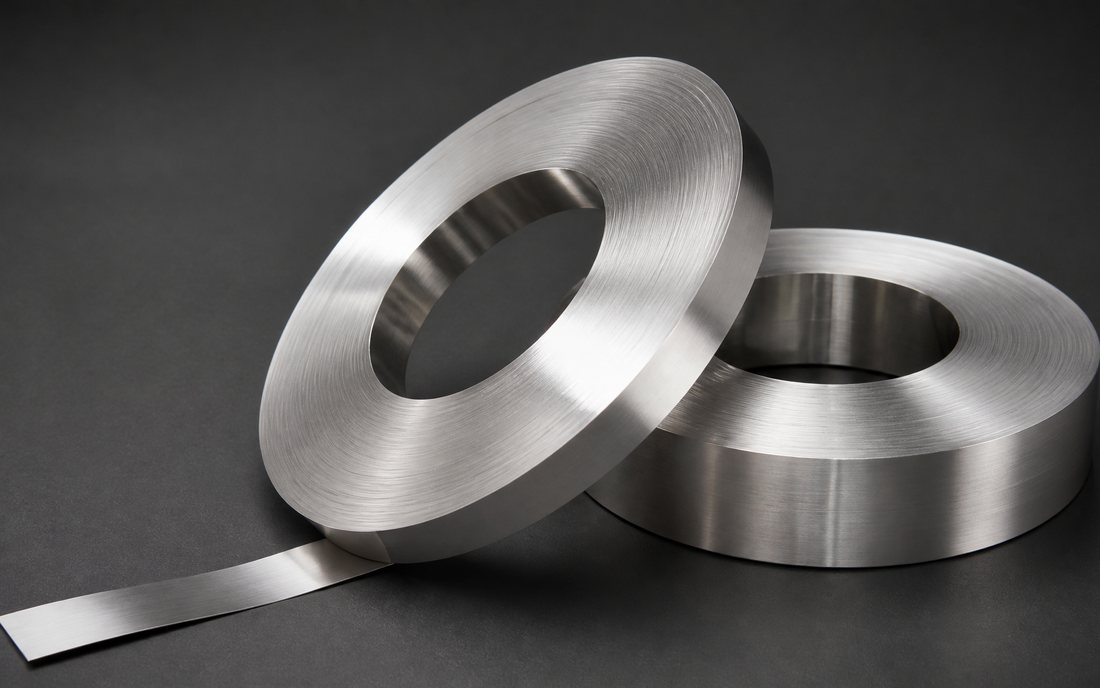
4J36
4J36 (UNS K93601) is a classic low-expansion iron-nickel alloy (commonly known as "Invar 36") optimized for ultra-low thermal expansion coefficient and exceptional dimensional stability. This alloy contains approximately 36% nickel—without cobalt, distinguishing it from cobalt-containing low-expansion alloys—forming a unique ordered alloy structure that minimizes thermal expansion across a critical temperature range. It maintains near-constant dimensions from -250 °C to 200 °C (-418°F to 392°F) and is widely used in industries requiring extreme dimensional precision, such as metrology, precision optics, and aerospace, where even microscale thermal deformation could lead to functional failure.
- UNS
- K93601
- Europe
- DIN 1.3912, EN 1.3912
- China
- GB/T 14985 – 2019 (4J36)
- Density
- 8.10 g/cm³
- Melting range
- 1430 – 1450 °C
- Delivery
- Annealed, degreased, edge-trimmed; magnetic properties on request.
What the spec says
Chemical composition in weight per cent and the standards we routinely certify to. Governing values are those printed on the EN 10204 certificate for your heat.
| Element | % |
|---|---|
| Ni | 35.0 - 37.0 |
| Fe | Balance |
| C | ≤ 0.03 |
| Mn | 0.30-0.60 |
| Si | 0.20-0.40 |
| S | ≤ 0.01 |
| P | ≤ 0.02 |
| Cr | ≤ 0.20 |
| Co | ≤ 0.50 |
| Form | Standard |
|---|---|
| Certified to the ASTM / AMS / EN edition named on your purchase order. | |
Behaviour that matters in service
- Ultra-Low Thermal Expansion — The 35 – 37% nickel content forms a Fe-Ni ordered alloy (Invar phase) that exhibits near-zero thermal expansion in the range of -250 °C to 200 °C—with a thermal expansion coefficient as low as 0.5×10⁻⁶/°C (-100 – 100 °C), far lower than most metals, making it the gold standard for dimensional stability.
- Exceptional Dimensional Stability — Maintains consistent dimensions even under extreme temperature fluctuations (e.g., from cryogenic to ambient), avoiding thermal warping that could disrupt precision alignment in optical systems or measurement tools.
- Balanced Mechanical Properties — Combines ultra-low expansion with sufficient tensile strength (≥480 MPa) and high ductility (≥28% elongation), enabling fabrication of complex components (e.g., thin-walled tubes, precision brackets) without cracking or deformation.
- High Precision Fabricability — Can be cold-rolled to ultra-thin strips with tight dimensional tolerance (±0.0005 mm) and machined to microscale precision using high-speed carbide tools; post-fabrication stress relief annealing (650 – 700 °C for 1 – 3 hours in vacuum) eliminates residual stresses, further enhancing long-term dimensional stability.
- Basic Corrosion Resistance — Offers moderate resistance to atmospheric oxidation and dry industrial environments, suitable for indoor precision equipment; for humid or marine environments, surface treatments (e.g., electroless nickel plating, passivation) are recommended to prevent rusting and maintain dimensional accuracy.
Typical applications
- Metrology & Standard Tools — Used in manufacturing precision gauges (e.g., length standards, calibration blocks), coordinate measuring machine (CMM) frames, and optical flat supports—providing consistent dimensions as a reference for global measurement standards.
- Precision Optical Equipment — Applied in optical lens mounts, laser interferometer bases, and telescope mirror cells—ensuring optical alignment remains stable under temperature changes, critical for high-resolution imaging and laser processing.
- Aerospace & Defense — Utilized in satellite structure frames, missile guidance system components, and cryogenic fuel tank brackets—withstanding extreme temperature variations in space or high-altitude environments while maintaining structural integrity.
- Semiconductor & Microelectronics — Employed in semiconductor wafer stage components, precision lead frames, and microchip packaging—preventing thermal expansion-induced damage to delicate circuits during manufacturing (e.g., lithography) or operation.
- Cryogenic Engineering — Used in cryogenic storage tank liners, liquid nitrogen (LN₂) transfer tubes, and superconducting magnet supports—maintaining dimensional stability at cryogenic temperatures (-196 °C) without brittle fracture.
- Medical Precision Equipment — Suitable for surgical robot arms, medical laser alignment components, and CT/MRI scanner frames—ensuring precise movement and imaging accuracy, even when exposed to body temperature or sterilization cycles.
How we ship 4J36
Melted in our own furnaces, tested in our own laboratory, and released with a certificate that matches the stamping on the bar or plate.
Forms
Round bar from 6 mm, plate, strip, seamless tube, open-die forgings and drawn wire.
Condition
Annealed, degreased, edge-trimmed; magnetic properties on request.
Documents
EN 10204 3.1 or 3.2, with chemistry, mechanical results and heat number traceability.
Inspection
SGS, BV, Intertek or your own inspector — welcomed before shipment.
Send the grade, the size, the quantity.
We will quote 4J36 against your specification — including lead time, inspection level and documents.