
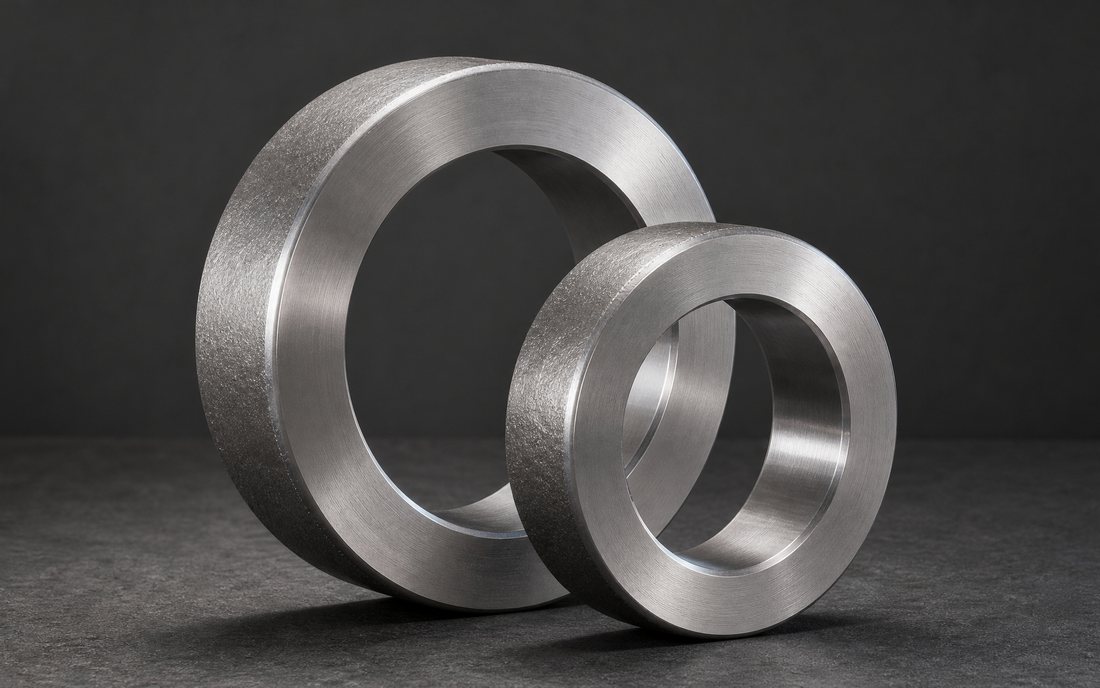
Inconel 600 or 601: oxidation resistance when the furnace cycles
Both alloys survive furnace atmospheres, but they protect themselves differently: 600 relies on chromia, 601 on alumina. The choice usually turns on how often the furnace cycles, what sulfur is present, and whether the part ever sees aqueous corrosion.
Inconel 600 and Inconel 601 are both nickel-chromium alloys answering the same brief: hold shape and resist oxidation in hot gas. They are not interchangeable in cyclic service. 600 is the older Ni-Cr workhorse, nominally 72% nickel, 14% chromium and 6% iron, single-phase austenite with no deliberate aluminium addition. 601 keeps 58.0–63.0% nickel but lifts chromium to 21.0–25.0% and adds 1.0–1.7% aluminium. That aluminium is the whole argument.
Two oxide scales, two failure modes
Chromia on 600: adequate in steady state
600 protects itself with a chromium oxide scale. In continuous service the scale is slow-growing and adherent, which is why the alloy is applied up to 1093 °C in furnace and heat-treatment work. Under thermal cycling the picture changes. Chromia and the metal beneath it expand at different rates, so the scale cracks on heating and spalls on cooling. Every spall exposes bare metal that must re-oxidise, and the cycle repeats. In a batch furnace, life is usually set by how much scale is lost per cycle rather than by the steady-state oxidation rate.
Alumina on 601: resistance to spalling
601 forms an aluminium oxide subscale under a thinner chromia layer. Alumina grows more slowly than chromia and, more importantly, adheres better when the part is thermally shocked. This is the basis of the 1200 °C oxidation rating published for 601 and the reason it is specified for muffles, radiant tubes, furnace rollers, burner nozzles, thermocouple protection tubes and other parts that see the door open.
The two grades side by side
| Inconel 600 | Inconel 601 | |
|---|---|---|
| UNS | N06600 | N06601 |
| Nickel | 72.0% nominal | 58.0 – 63.0% |
| Chromium | 14.0% nominal | 21.0 – 25.0% |
| Iron | 6.0% nominal | 7.7 – 17.4% |
| Aluminium | not specified | 1.0 – 1.7% |
| Carbon | not specified in our data sheet | ≤ 0.10% |
| Density | 8.47 g/cm³ | 8.11 g/cm³ |
| Melting range | 1354 – 1413 °C | 1360 – 1411 °C |
| Protective scale | chromia | alumina under chromia |
| Published oxidation rating | 1093 °C | 1200 °C |
| Cyclic spalling | progressive, life-limiting | markedly lower |
| Bar specification | ASTM B166, AMS 5580 | ASTM B166, AMS 5870 |
| Plate specification | ASTM B168, AMS 5540 | ASTM B168, AMS 5715 |
Where 600 is still the correct call
- Continuous high-temperature duty. A muffle or retort that is brought up once and held for months never exercises the spalling mechanism, so the chromia scale is adequate and the cheaper, more available grade is the rational choice.
- Reducing or sulfur-bearing gas. An alumina scale needs a minimum oxygen potential to form and repair itself. In strongly reducing or sulfur-rich atmospheres 601 loses its advantage, and the higher nickel content of 600 is the more useful attribute.
- Aqueous and wet-process corrosion. 601 is an oxidation alloy, not a corrosion alloy. 600 has a long record in chloride-bearing water and was for decades the default steam generator tube grade; where primary-side stress corrosion cracking became the limiting mechanism, 690 at 27.0–31.0% chromium replaced it, not 601.
- Mixed inventories. If a plant already runs 600 tube and 600 bar, adding 601 for one component creates a second heat, a second certificate and a second set of weld procedures for little gain.
Where 601 pays for itself
- Real thermal cycling. Batch furnaces, bell furnaces, quench fixtures, kiln furniture and any part that is force-cooled. This is the case the grade was designed for.
- Peak temperature above roughly 1000 °C in air. The 1093 °C / 1200 °C split is where the two ratings separate.
- Where spalled oxide is a defect source. Scale falling onto workpieces, into a gas path, or onto a catalyst bed is a quality problem, not a maintenance problem.
- Where section loss must be predictable. Slow, adherent scale growth makes remaining-wall estimates more reliable between turnarounds.
Fabrication notes that affect the order
Neither grade responds to heat treatment for strength; both are supplied annealed, and property differences between heats come from chemistry and processing rather than from a hardening treatment. 601 is the more awkward of the two to weld, not because of cracking but because the annealing and hot-working oxide it carries is alumina-rich and must be removed by pickling or grinding before welding and before any coating. Welding through that film is a common cause of lack of fusion. 600 needs the same cleanliness discipline but the oxide is easier to strip.
Specify the condition on the purchase order rather than assuming it: annealed and descaled, pickled, or ground. The surface state is part of the specification and it changes both the price and the weldability.
What to send us before we quote
Four inputs decide the grade and the price. Send them and the enquiry can be answered once instead of three times.
- Temperature profile. Peak metal temperature, continuous or cyclic, cycle frequency, and how the part cools — in the furnace, in air, or quenched.
- Atmosphere. Air, combustion gas, endothermic or exothermic gas, oxygen potential, and sulfur or chlorine level. Reducing duty points to 600; oxidising cyclic duty points to 601.
- Form and size. Bar, plate, sheet, tube or wire, with dimensions, quantity and whether the part is machined from bar or formed from sheet. Because the densities differ — 8.47 against 8.11 g/cm³ — a per-kilogram comparison does not translate into a per-part comparison, so ask for both figures.
- Specification and testing. The ASTM or AMS callout, whether a certified chemistry and mechanical report is enough, and whether ultrasonic inspection, PMI, grain size or a third-party witness is required.
The decision rule. If the part returns to room temperature regularly and the peak exceeds about 1000 °C, specify 601. If service is continuous below that, or the gas is reducing or sulfur-bearing, or the part sees aqueous chloride, specify 600. If one component has to survive both cyclic oxidation and wet chloride attack, neither grade is the answer — move to 690 for the chromium or to a 625-type alloy, and re-check the design before fixing the material.
Values quoted here follow the ASTM / EN edition named in each paragraph. For a specific heat, the governing numbers are those printed on the EN 10204 certificate that ships with the material. Written by the technical desk at Shanghai Hangbo Alloy Group.
Send the grade, the size, the quantity.
We will quote against your specification, including lead time, inspection level and documents.