
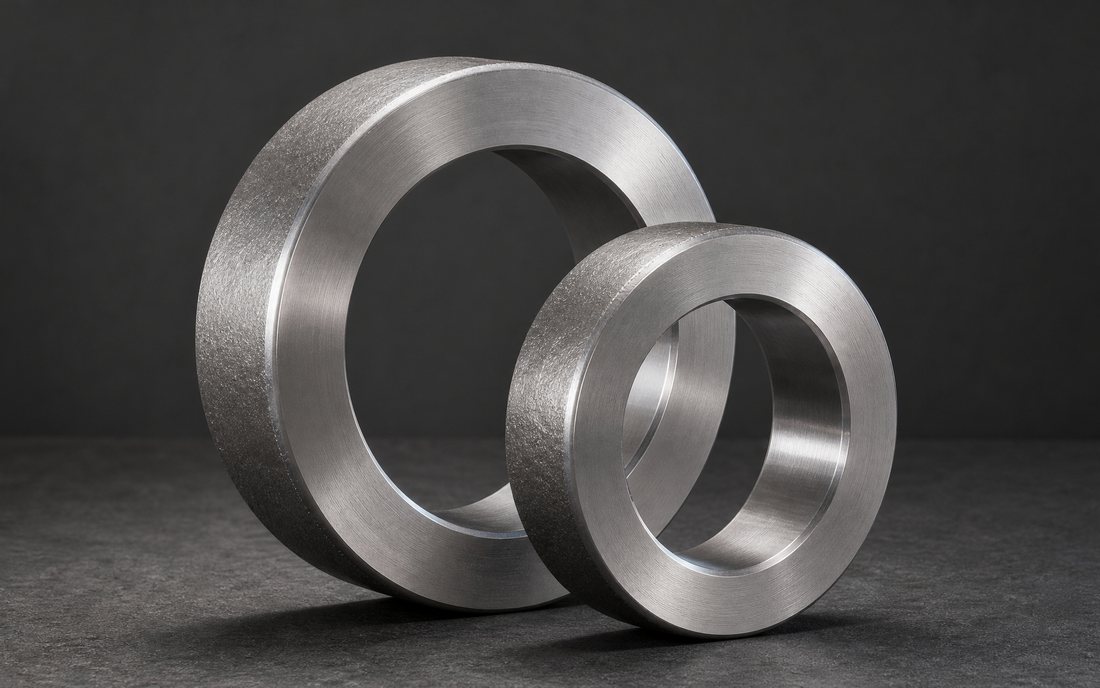
Inconel 602CA for furnace rolls and radiant tubes
602CA is specified with 0.15–0.25% carbon and 1.8–2.4% aluminium in a balance-nickel matrix, and rated to 1250 °C. What that buys in a furnace roll or a radiant tube, where 601 and 310S stop, and what the mill needs on the enquiry.
Inconel 602CA, UNS N06025, is specified for industrial furnace components, radiant tubes and fixtures, and for chemical-process equipment such as retorts and heating elements exposed to carburising and nitriding conditions. Its oxidation limit is 1250 °C, roughly where the leaner grades stop: 310S is rated to 1150 °C in air, Inconel 601 to 1200 °C. What separates 602CA is not one superior number but a composition that keeps its oxide attached while the furnace cycles.
What actually ends a furnace roll's life
A roll seldom fails because the alloy was too weak on the day it went in. It fails because the protective oxide detaches on every shutdown, the wall thins where the scale lifted, and the section left eventually sags, ovalises or cracks. A radiant tube fails the same way from outside, and separately from inside when the process gas carburises the wall.
That is why the useful comparison between high-temperature grades is surface behaviour, not room-temperature tensile data. A grade that keeps a coherent oxide through repeated cycles keeps its section; a grade whose scale spalls hands the section back to the atmosphere a few tenths of a millimetre at a time. 310S forms a dense, stable chromium oxide film and resists spalling, up to 1150 °C. 601 adds aluminium and is rated to 1200 °C with good spalling resistance. 602CA carries more aluminium again and is rated to 1250 °C.
Three things that separate 602CA from 601
Carbon is the first. 602CA is specified at 0.15–0.25 %, against ≤0.10 % in 601 and ≤0.08 % in 310S. That is deliberate: at this level carbon puts carbide into the grain boundaries, and a boundary pinned by carbide does not slide as readily when the component sits under load for years: for a roll spanning a hearth, that is the difference between straight and bowed at the end of a campaign.
Aluminium is the second. At 1.8–2.4 % it is roughly twice the 601 addition of 1.0–1.7 %, and 310S carries no aluminium requirement at all. Aluminium forms the subscale that keeps the outer oxide attached across a heating and cooling cycle, which is the mechanism that decides roll life in a batch furnace.
The third is how tightly the minor additions are held. Titanium sits at 0.1–0.2 % and zirconium at 0.01–0.12 % — windows rather than residual allowances — and iron is banded at 8.0–11.0 %, where 601 allows 7.7–17.4 %. A certificate that says only "602CA" is not enough to accept a heat: read the chemistry element by element against these windows.
The specification, limit by limit
| Inconel 602CA | Inconel 601 | 310S | |
|---|---|---|---|
| UNS | N06025 | N06601 | S31008 |
| European designation | DIN 2.4633 | DIN 2.4851 | EN 1.4845 |
| Nickel | balance | 58.0 – 63.0% | 19.0 – 22.0% |
| Chromium | 24.0 – 26.0% | 21.0 – 25.0% | 24.0 – 26.0% |
| Iron | 8.0 – 11.0% | 7.7 – 17.4% | balance |
| Carbon | 0.15 – 0.25% | ≤ 0.10% | ≤ 0.08% |
| Aluminium | 1.8 – 2.4% | 1.0 – 1.7% | not specified |
| Titanium | 0.1 – 0.2% | not specified | not specified |
| Zirconium | 0.01 – 0.12% | not specified | not specified |
| Silicon | ≤ 0.50% | ≤ 0.50% | ≤ 1.50% |
| Manganese | ≤ 0.15% | ≤ 1.00% | ≤ 2.00% |
| Sulphur | ≤ 0.010% | ≤ 0.015% | ≤ 0.030% |
| Density | 7.94 g/cm³ | 8.11 g/cm³ | 7.98 g/cm³ |
| Melting range | 1370 – 1425 °C | 1360 – 1411 °C | 1398 – 1454 °C |
| Oxidation limit, continuous | up to 1250 °C | up to 1200 °C | up to 1150 °C |
Nickel is reported as balance, which is normal for this family but means chemistry has to be checked element by element, not against a single figure. A quotation substituting 601 or 310S is not comparing like with like on carbon and aluminium.
Rolls and radiant tubes load differently
A roll carries its own weight plus the charge across a span, so the design variable is stiffness at temperature. Diameter is usually fixed by the hearth geometry, so the alloy has to supply the creep resistance, and metal lost to oxidation is section lost from the outside in. A tube is a pressure part: it holds hoop stress while the outside oxidises and the inside may carburise. Both duties reward the same property, structural stability under prolonged thermal exposure, but they are checked against different documents: a tube order should name ASTM B167, not a plate specification.
Product forms and the documents behind them
602CA is produced against a separate document for each form: plate to ASTM B168 and ASME SB-168, round bar to ASTM B166 and AMS 5873, seamless tube to ASTM B167 with DIN 2.4633 as the European designation, and forgings to ASTM B564 and ASME SB-564. A drawing that calls for 602CA bar without a condition leaves the mill to choose between hot-finished and annealed stock, and a forging is not a bar.
Fabrication and repair welding
The grade is weldable and formable by ordinary shop methods, which matters because a furnace roll is rarely replaced as one piece: it is cut out, the worn length is rebuilt or a new section welded in. Whether that repair is acceptable is for the operator and the inspector, not the mill, so say at quotation stage whether weld repair is permitted and whether it will be examined.
What to specify on the order
- Metal temperature, average and peak — measured at the roll surface or tube wall, not taken from the furnace setpoint.
- Atmosphere — oxidising, carburising, nitriding, sulphur-bearing, or cycling between them. 602CA is chosen for the carburising cases; for clean oxidising duty at lower temperature, 310S may do.
- Section — diameter and length for a roll, wall thickness for a tube, with the machining allowance stated.
- Form and condition — plate, bar, seamless tube or forging, and the standard that governs it.
- Inspection document — a 3.1 certificate with chemistry and mechanical results per heat, or 3.2 with witnessed testing.
What to send us
Send the form and the standard, the section drawing with tolerances, the metal temperature and the atmosphere, the quantity, and the inspection document you need. With those five facts we will quote 602CA against the correct specification, or say plainly that 310S or 601 will carry the duty for less money.
Values quoted here follow the ASTM / EN edition named in each paragraph. For a specific heat, the governing numbers are those printed on the EN 10204 certificate that ships with the material. Written by the technical desk at Shanghai Hangbo Alloy Group.
Send the grade, the size, the quantity.
We will quote against your specification, including lead time, inspection level and documents.