
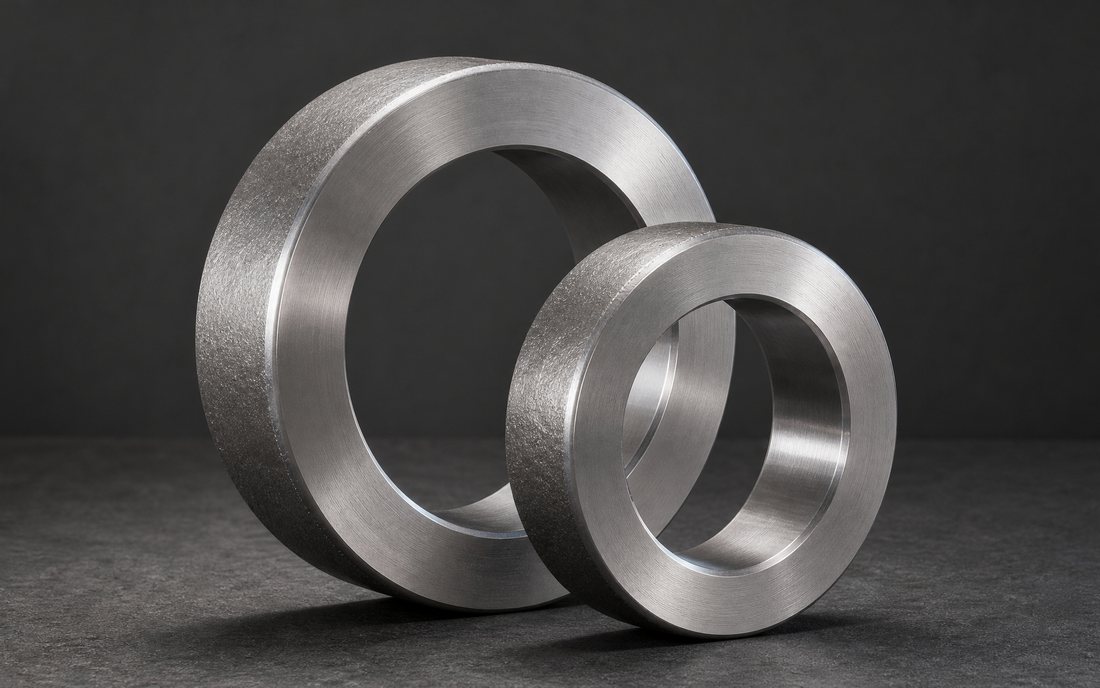
Inconel 617 or 625 above 800 °C
Both are nickel-chromium alloys with 8–10% molybdenum, so room-temperature datasheets look alike. Above 800 °C they are limited by different mechanisms: 617 by creep and scale adhesion, 625 by a precipitate that does not survive.
Inconel 617 and Inconel 625 sit side by side in most high-temperature alloy tables, and at room temperature their datasheets read alike: both are nickel-chromium alloys carrying 8–10% molybdenum and roughly 20–24% chromium. Above 800 °C the resemblance stops being useful. The two grades are limited by different mechanisms, and the choice usually turns on whether the part carries load at temperature or only has to survive it.
What changes above 800 °C
Three things happen at once. Tensile strength stops being the design value and creep rupture becomes the limit, so the useful question is no longer what the alloy tests at on delivery but how long it lasts at what stress. The protective oxide becomes a life-limiting feature rather than a surface finish. And the precipitates that give each alloy its room-temperature properties begin to coarsen, dissolve or transform, so a short-term hot tensile result tells you very little about two years of service.
That is why the two grades diverge so sharply in this range. 617 was built around a stable precipitate and an alumina-forming surface. 625 was built around solid-solution strengthening and niobium carbide, with a precipitate that is deliberately unstable at these temperatures.
| Inconel 617 | Inconel 625 | |
|---|---|---|
| UNS | N06617 | N06625 |
| Nickel | ≥ 44.5% | ≥ 58.0% |
| Chromium | 20.0 – 24.0% | 20.0 – 23.0% |
| Molybdenum | 8.0 – 10.0% | 8.0 – 10.0% |
| Cobalt | 10.0 – 15.0% | not specified |
| Aluminium | 0.8 – 1.5% | ≤ 0.4% |
| Niobium + tantalum | not specified | 3.15 – 4.15% |
| Iron | ≤ 3.0% | ≤ 5.0% |
| Carbon | 0.05 – 0.15% | ≤ 0.10% |
| Density | 8.36 g/cm³ | 8.44 g/cm³ |
| Melting range | 1335 – 1380 °C | 1290 – 1350 °C |
| Strengthening | gamma-prime, cobalt-stabilised | solid solution plus carbide |
Why 617 holds its shape at temperature
617 carries 10.0–15.0% cobalt and 0.8–1.5% aluminium, and those two additions do most of the high-temperature work. Cobalt raises the solvus of the gamma-prime phase and slows its coarsening, so the strengthening precipitate is still present after thousands of hours instead of a few hundred. Aluminium does two jobs: it takes part in gamma-prime, and it forms a thin alumina subscale beneath the chromia layer, which is what keeps the scale attached when a furnace cycles instead of flaking away and leaving bare metal behind.
The iron ceiling matters as much as the alloying. 617 is held to ≤3.0% iron with ≥44.5% nickel, which stops the matrix being diluted by a ferrite-forming element; 625 permits up to 5.0%. Carbon at 0.05–0.15% is high for a corrosion-resistant alloy, and deliberately so: the grain-boundary carbides it forms pin the boundaries against sliding, which is the creep mechanism that governs life at 800 °C and above.
Oxidation and carburisation resistance is rated to roughly 1100 °C in continuous service, which is why the grade appears in combustion cans, transition ducts, radiant tubes and the 700 °C-class steam piping now being qualified for advanced power cycles.
Where 625 is still the right call
625 is a solid-solution alloy in the specification sense. Its strength comes from molybdenum and niobium held in solution plus niobium carbide, and the gamma-double-prime precipitate that makes it strong around 650 °C is not a long-term proposition at 800 °C: it coarsens and converts to the delta phase, and the strength shown on the delivery certificate quietly leaves. For a loaded part at 800 °C with a design life in years, that is disqualifying.
What 625 does better is survive. Its nickel floor is 58.0% against 44.5% for 617 and its iron ceiling is looser, which gives more margin in chloride and reducing-acid service; the molybdenum addition is identical, but the higher-nickel matrix makes better use of it. Where the duty is hot gas, thermal cycling and field weld repair rather than sustained stress — bellows, expansion joints, ducting, thermocouple protection tubes, damper seals — 625 is often the cheaper adequate answer, and it is the more forgiving of the two to weld on site.
Decision rule
- Sustained load above 800 °C: 617. Springs, hangers, internal supports, rotating parts and pressure-boundary components all fall here.
- Temperature without sustained stress: 625 is normally sufficient and less costly, particularly where the atmosphere also carries chlorides or reducing acids.
- Repeated thermal cycling on a stressed section: 617, because the alumina subscale survives spallation cycles that progressively thin a chromia-only scale.
- Weld overlay or cladding on a carbon steel shell: 625, applied without post-weld heat treatment.
- Above roughly 1100 °C continuous: neither. Move to 602CA, rated to 1250 °C, or to a ceramic.
What to send with the enquiry
A grade name alone cannot be quoted properly. Send the metal temperature — average and peak, not the process setpoint — and say whether the part is loaded and for how long. Describe the atmosphere (oxidising, carburising, sulphidising, or cycling between them), because that decides whether an alumina former is required. Give the section size, since it sets the forging reduction and the test location, and state whether weld repair is permitted in service. Finally, name the inspection document you need: a 3.1 certificate with chemistry and mechanical results per heat, or 3.2 with witnessed testing. With those five facts we will quote 617 or 625 — or say plainly that neither fits.
Values quoted here follow the ASTM / EN edition named in each paragraph. For a specific heat, the governing numbers are those printed on the EN 10204 certificate that ships with the material. Written by the technical desk at Shanghai Hangbo Alloy Group.
Send the grade, the size, the quantity.
We will quote against your specification, including lead time, inspection level and documents.