
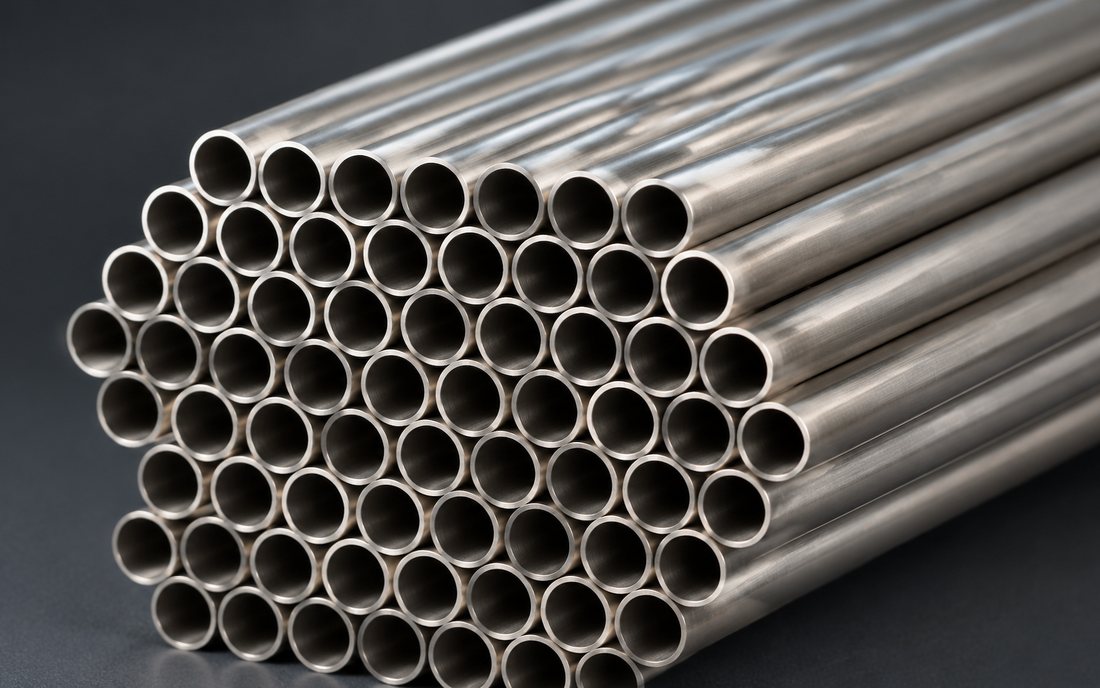
Monel 400 in hydrofluoric acid service
Hydrofluoric acid is the one duty where a nickel-copper alloy is chosen before anything else is considered. What N04400 does in HF, what the water content and aeration change, and what the specification has to state.
Hydrofluoric acid is the duty that settles metallurgy before anything else is discussed. It is a weak acid on paper and an aggressive one in a plant: it strips the oxide film that protects stainless steel, dissolves glass and refractory, and does not become harmless when diluted. For a mill the practical consequence is narrow. Where the stream is aqueous HF, the material is Monel 400, and the remaining questions are about condition, product form and stream analysis, not the grade name.
Why HF is a separate case
Stainless steels and nickel-chromium alloys resist most acids by keeping a passive oxide layer intact. HF removes that layer, and it does so at concentrations where other acids would be unremarkable. Once the film is gone the metal is bare and the alloy's own chemistry sets the corrosion rate.
Nickel does not depend on a passive oxide in HF. The fluoride that forms on its surface stays thin and adherent instead of dissolving away, so the alloy works without an oxide layer at all. Copper at 28.0–34.0% adds resistance in reducing acids and in seawater, and it is what separates this alloy from unalloyed nickel in the same duty.
What N04400 is, in specification terms
Monel 400 is a nickel-copper alloy, not a gamma-prime strengthened superalloy: it gains its strength from solid solution and from cold work, and it is supplied annealed. Nickel at ≥63.0% is the base and the reason it works in HF; copper at 28.0–34.0% is the second element, not a minor addition. Iron is capped at ≤2.50%, manganese at ≤2.00% and carbon at ≤0.30%.
| Monel 400 | |
|---|---|
| UNS | N04400 |
| Europe | DIN 2.4360, EN 2.4360 |
| Nickel | ≥ 63.0% |
| Copper | 28.0 – 34.0% |
| Iron | ≤ 2.50% |
| Manganese | ≤ 2.00% |
| Carbon | ≤ 0.30% |
| Silicon | ≤ 0.50% |
| Sulfur | ≤ 0.024% |
| Density | 8.80 g/cm³ |
| Melting range | 1300 – 1350 °C |
| Plate | ASTM B164, ASME SB-164 |
| Round bar | ASTM B165, ASME SB-165 |
| Seamless tube | ASTM B163, ASME SB-163, DIN 2.4360 |
| Forgings | ASTM B564, ASME SB-564 |
| Wire | ASTM B165, ASME SB-165 |
Two numbers carry more weight than the rest in HF service. The nickel floor of ≥63.0% is not a typical value to be traded away: a heat sitting at the bottom of the copper range and the top of the iron range behaves as a different alloy in hot acid, so the certificate should be read element by element, not as a statement of compliance. Carbon at ≤0.30% is high for a corrosion-resistant material, and it is one reason the annealed condition matters: carbide on the grain boundaries is a path, and HF duty is usually also welded fabrication.
What actually decides the answer
| Duty | Usual material | Why | What to confirm |
|---|---|---|---|
| Anhydrous HF, no water present | Carbon steel | Dry acid does not ionise, so the electrochemical cell that drives attack never forms | Water at start-up and shutdown; any aqueous phase that can condense |
| Aqueous HF, all concentrations up to boiling | Monel 400 (N04400) | Nickel holds across the concentration range; copper covers the reducing side | Peak metal temperature, air ingress, chloride content |
| HF carrying dissolved air or an oxidising addition | Monel 400 only with the oxidant removed | Oxidisers raise the corrosion rate on a copper-bearing alloy | Whether the loop is deaerated, and what is dosed into it |
| HF with sulphuric acid or heavy chlorides, such as spent acid | Selection leaves single-grade territory | A mixed stream is not described by the behaviour of either acid alone | The full stream analysis, not the stream name |
The first row explains most of the confusion here. Anhydrous HF is handled in carbon steel because there is no water to ionise the acid; the moment water appears, the same line belongs in Monel. Which row a line falls into is a process decision, and it should be written down before the purchase order, not after the first inspection.
Where the alloy is not enough
Three conditions move the answer away from Monel 400. Dissolved air or an oxidising addition raises the corrosion rate on a copper-bearing alloy, so a deaerated loop and an aerated one are not the same duty at the same acid strength. High velocity and entrainment attack the same weakness mechanically. Temperature is the third: the alloy's own service range runs from cryogenic to about 482 °C, a property of the material, not a licence to run hot HF. Where the acid is hot and concentrated, or carries a second acid, selection stops being routine and the full stream analysis has to be on the table.
Fabrication rules that matter in HF
Monel 400 is supplied annealed and is normally used in that condition. Heavy cold forming leaves residual stress and should be followed by a stress relief; welding is done with matching nickel-copper filler, without preheat, on clean dry surfaces. The rule broken most often is contamination. Carbon steel brushes and grinding wheels leave embedded iron on the surface, that iron corrodes first in HF, and the products end up in the acid. Dedicated stainless or nickel-alloy tooling, and a pickled finish after fabrication, belong in the specification, not in site housekeeping.
- Form and standard — plate to ASTM B164 or ASME SB-164; bar to ASTM B165 or ASME SB-165; seamless tube to ASTM B163, ASME SB-163 or DIN 2.4360; forgings to ASTM B564 or ASME SB-564.
- Condition — annealed, with the hardness or tensile level stated if the part is machined after delivery.
- Surface — pickled and passivated, with iron contamination excluded after fabrication.
- Documents — a 3.1 certificate with chemistry and mechanical results per heat, or 3.2 with witnessed testing.
What to send us
Send the acid concentration and the water content, the metal temperature at the hottest point rather than the process setpoint, whether the loop is aerated, and the second components in the stream — chlorides, sulphuric acid, fluorides of other metals. Add the form, size, quantity and inspection document. With those facts we will confirm N04400 or say where it stops being adequate. Specifications and product forms are on hangbonickel.com; enquiries go to vicky@hangboalloy.com.
Values quoted here follow the ASTM / EN edition named in each paragraph. For a specific heat, the governing numbers are those printed on the EN 10204 certificate that ships with the material. Written by the technical desk at Shanghai Hangbo Alloy Group.
Send the grade, the size, the quantity.
We will quote against your specification, including lead time, inspection level and documents.