
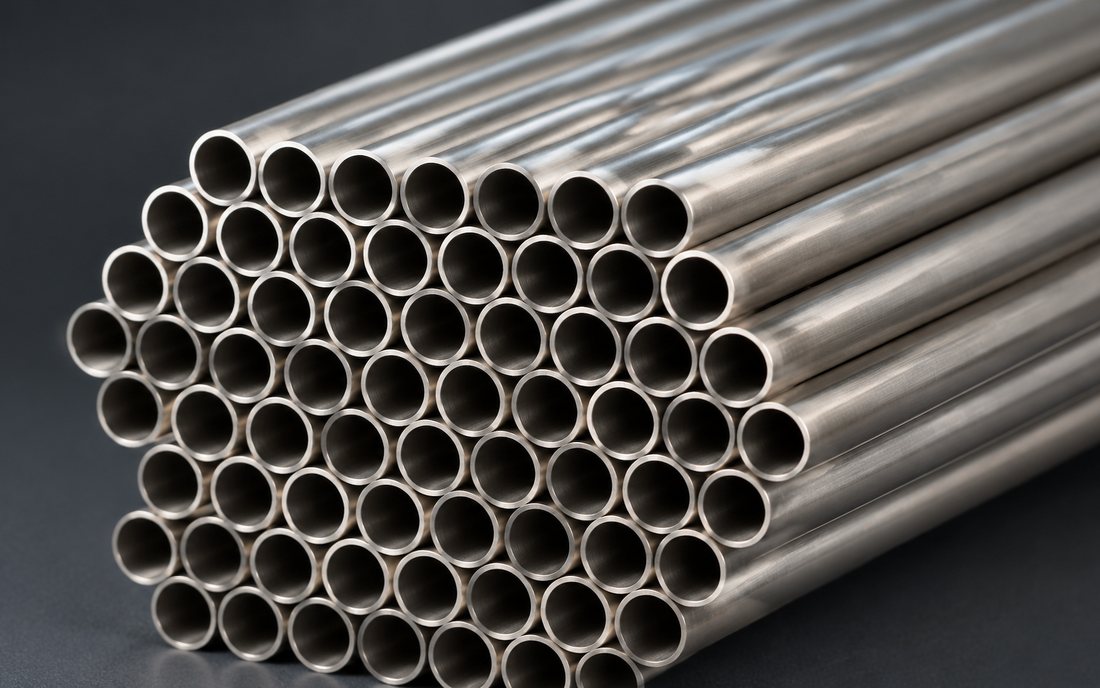
Monel 401 for thermocouple sheathing and resistance elements
Monel 401 is the Monel a buyer picks for clean machining. Where N04401 fits in thermocouple sheathing and resistance elements, what the silicon cap does, and why the grade stops at about 427 °C.
Monel 401 is the member of the Monel family that a buyer specifies for one reason: it machines cleanly. In thermocouple sheathing and resistance-element work that matters twice over. A sheath is a long, thin-walled seamless tube that has to be drawn straight, closed at the tip and machined into a gland or fitting, while a resistance element has to hold a close section and a stable value across a batch. The alloy that breaks its chip instead of stringing it, and stays predictable at temperature, is the one that keeps both jobs on tolerance. It is also the one part of the family where silicon is written into the specification, and that small change is what moves it out of general corrosion duty and into precision parts.
What N04401 is, in specification terms
Monel 401 (UNS N04401) is a nickel-copper-silicon alloy, not a hardened superalloy. Its strength comes from solid solution and from cold work, and it is supplied annealed. Nickel at 40.0–45.0% and copper at 51.4–56.4% form the base; the copper side of the composition is what gives the grade its low-temperature toughness and its steady electrical behaviour relative to plain nickel. The specification caps iron at ≤0.75%, manganese at ≤2.25%, carbon at ≤0.10% and sulfur at ≤0.015%. In Europe the grade is DIN 2.4363 / EN 2.4363. As with every nickel-copper heat we melt, the certificate — not the trade name — is what fixes the composition.
| Monel 401 | |
|---|---|
| UNS | N04401 |
| Europe | DIN 2.4363, EN 2.4363 |
| Nickel | 40.0 – 45.0% |
| Copper | 51.4 – 56.4% |
| Silicon | ≤ 0.25% |
| Iron | ≤ 0.75% |
| Manganese | ≤ 2.25% |
| Carbon | ≤ 0.10% |
| Sulfur | ≤ 0.015% |
| Density | 8.91 g/cm³ |
| Melting range | 1290 – 1340 °C |
| Tensile (annealed, RT) | 540 – 690 MPa |
| Yield (annealed, RT) | 230 – 340 MPa |
| Elongation | 25 – 35% |
Why the silicon cap matters
Silicon is the deliberate difference between N04401 and the better-known Monel 400. It is limited to ≤0.25%, and inside that limit it does one thing a machinist notices immediately: it shortens the chip so the metal breaks cleanly instead of stringing, which reduces tool wear and lets a shop run faster on small, tight-tolerance parts. That is why the grade turns up in threaded glands, valve stems, gears and sensor housings, where the shape is more work than the metal.
The cap is a ceiling, not a target. A heat that runs over it is not N04401, and “close enough” does not apply. We check silicon on every heat certificate the same way we check nickel.
The temperature ceiling: about 427 °C
Monel 401 is documented for stable mechanical properties from cryogenic conditions up to roughly 427 °C (800 °F). Below zero it stays tough rather than turning brittle, which is why it appears in low-temperature instrument work. Above that ceiling it is outside the grade’s stated range, and a mill will not warrant it for a sheath that runs hotter. If the duty sits above 427 °C, the answer is a chromium-bearing sheath alloy, not a heavier Monel section. The 427 °C figure is a service limit, not a proof-strength figure, and it is the number that should appear in your inquiry.
Sheath tube and resistance stock: what to put on the order
For sheathing the product form is seamless tube to ASTM B163 / ASME SB-163, with the European designation DIN 2.4363. Bar and wire for resistance elements and machined fittings go to ASTM B165 / ASME SB-165, plate to ASTM B164 / ASME SB-164 and forgings to ASTM B564 / ASME SB-564. At room temperature the annealed material typically shows a tensile strength of 540–690 MPa, a yield strength of 230–340 MPa and 25–35% elongation.
State the following on the purchase order so the quotation does not have to be reworked:
- Product form, outside diameter and wall for a sheath, or diameter and section for resistance stock.
- The governing standard and any mill certificate requirement, so the EN 10204 document matches.
- The condition: annealed, or cold-worked if a higher strength or a specific hardness is called for.
- The temperature the part actually sees, so we can confirm it sits inside the 427 °C ceiling.
Where the alloy stops
Monel 401 resists seawater, brine, mild sulfuric acid and alkaline solutions, and its electrical conductivity is comparable to Monel 400. It is not a high-temperature heating element: it is a sheath and low-temperature resistance alloy, and in strongly oxidising acids or above its temperature ceiling it is the wrong grade. When a customer asks for a resistance element that must glow red, we say so and move them to the alloy that belongs there. A wrong grade sold quietly becomes a failed part later, and that costs more than an honest conversation now.
What to send us
Send the grade, the form, the outside diameter and wall or the section, the quantity, and the temperature the part will see. We will quote against your specification on hangbonickel.com — lead time, inspection level and the documents that ship with the material included — and answer at vicky@hangboalloy.com.
Values quoted here follow the ASTM / EN edition named in each paragraph. For a specific heat, the governing numbers are those printed on the EN 10204 certificate that ships with the material. Written by the technical desk at Shanghai Hangbo Alloy Group.
Send the grade, the size, the quantity.
We will quote against your specification, including lead time, inspection level and documents.