
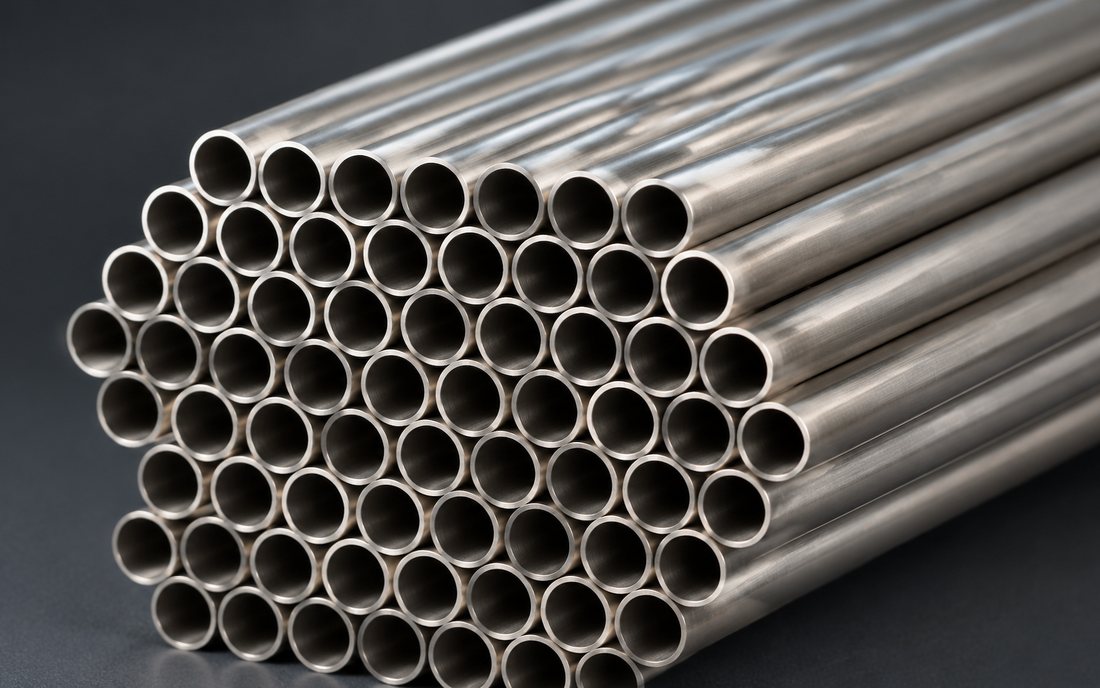
Monel K-500 pump shafts: ageing, straightness and galling
K-500 gives a seawater pump shaft roughly double the yield strength of annealed Monel 400, but the ageing treatment that delivers it also moves the bar, and hardness alone does not stop a rubbing surface from galling. What to put on the drawing, and in what order.
Monel K-500 (UNS N05500) is what most pump specifications reach for when a shaft has to run in seawater or brine under real bearing load. It is the Monel nickel-copper base with aluminium and titanium added and a two-step heat treatment behind it, and the ageing is the point: tensile strength above 1000 MPa and yield strength of at least 760 MPa. What follows from that treatment — distortion during ageing, straightness afterwards, and the behaviour of rubbing surfaces — decides whether the shaft works.
What the grade actually is
Chemistry is where to start: the aluminium and the titanium are what make the grade. Nickel is held at ≥ 63.0% and copper at 27.0 – 33.0%, the Monel base; aluminium at 2.30 – 3.15% and titanium at 0.35 – 0.85% are the additions that precipitate on ageing. Iron is capped at ≤ 2.00%, carbon at ≤ 0.18%, manganese at ≤ 1.50%, silicon at ≤ 0.50% and sulphur at ≤ 0.010%.
Bar for shaft work is ordered to ASTM B865 / ASME SB-865, which is worth writing on the purchase order: the Monel 400 bar specification is ASTM B165, a different document with a different chemistry table. Forgings fall under ASTM B564 / ASME SB-564, plate under ASTM B127, seamless tube under ASTM B165 and DIN 2.4375. The European designation is 2.4375, the Chinese NS3307; density 8.47 g/cm³, melting range 1300 – 1350 °C.
Monel K-500 against Monel 400, on the values a shaft drawing cares about
Most K-500 enquiries are an upgrade from 400, so the pair is worth setting side by side.
| Monel K-500 | Monel 400 | |
|---|---|---|
| UNS | N05500 | N04400 |
| Nickel | ≥ 63.0% | ≥ 63.0% |
| Copper | 27.0 – 33.0% | 28.0 – 34.0% |
| Aluminium | 2.30 – 3.15% | not specified |
| Titanium | 0.35 – 0.85% | not specified |
| Iron | ≤ 2.00% | ≤ 2.50% |
| Carbon | ≤ 0.18% | ≤ 0.30% |
| Density | 8.47 g/cm³ | 8.80 g/cm³ |
| Melting range | 1300 – 1350 °C | 1300 – 1350 °C |
| Strengthening | precipitation (Al + Ti) | solid solution |
| Condition for a shaft | anneal 1040 °C, then age 450 – 550 °C | annealed |
| Hardness after ageing | up to 300 HB | not specified |
Ageing: the two-step that sets the properties
The treatment is a solution anneal at 1040 °C followed by ageing at 450 – 550 °C. The anneal puts aluminium and titanium into solution and leaves a soft, workable structure; the age precipitates the nickel-aluminium-titanium phase that carries the strength. Hardness reaches up to 300 HB, and that figure governs the machining sequence.
The alloy machines best in the annealed condition, and that sets the route: rough machine annealed, age, then finish and grind. A shaft finished to size before ageing will move in the furnace and then have to be re-cut at full hardness — slow, expensive and hard on a bearing journal.
Welding is the other constraint: K-500 can be welded, but needs pre-heating and a post-weld heat treatment to restore strength and corrosion resistance, and the weld will not fully match the aged parent metal, so a welded flange is a different quotation from one machined from solid.
Straightness after ageing
Ageing is a soak at temperature for hours, and no straightening operation leaves a bar free of residual stress. When that bar goes through the age, the stress is released and the bar moves. The amount cannot be read off the certificate: it depends on diameter relative to length, on how the bar was straightened, and on how evenly the rough machining removed material.
The practical control is sequence, not tolerance. Either buy bar supplied aged and straightened, and machine it with light cuts, or buy it solution annealed, rough machine, age in the rough, straighten, then finish grind. Re-straightening after ageing leaves residual stress of its own, and a slender shaft straightened cold after the age can relax in service, so the straightening belongs before the final grind, not after it.
On the drawing, state straightness as a total indicator reading over a defined length, with support positions named, and say whether it is checked before or after final machining. A call-out with no datum is quoted as written and argued about later.
Galling on threads and bearing fits
Galling catches people out on K-500 because the material is hard after ageing, and hardness is easily mistaken for sliding tolerance. It is not: galling is a property of the couple, and two surfaces of the same alloy, high contact pressure, no lubricant film and relative movement add up to cold welding and tear-out. On a pump shaft it appears at the impeller fit, under a press-fitted sleeve and on threads made up repeatedly.
- Break the couple. A dissimilar material on the nut, bushing or sleeve removes the condition that starts the damage.
- Keep a film between the surfaces. Assembly compound on press fits and lubricant on threads cost less than a replacement shaft.
- Specify thread form and finish. Rolled threads behave better than rough cut threads under repeated make-up.
- Do not re-use galled fasteners. A galled thread has already lost its fit, and re-torquing it transfers the damage.
None of this argues against K-500 for a shaft — it argues for designing the interfaces as carefully as the shaft.
Corrosion duty the shaft will see
The grade is rated from cryogenic temperature to approximately 482 °C, and its corrosion resistance covers seawater, brine, sulphuric acid and alkaline solutions, including resistance to pitting, crevice corrosion and stress corrosion cracking. That is the 400 inheritance, and why the grade is specified for propeller shafts, pump impellers and wellhead components.
One caution on the ceiling: the service limit of approximately 482 °C sits inside the 450 – 550 °C ageing range, so prolonged exposure near it is not the same as a short excursion. A shaft that runs hot should have its aged condition discussed before the order is placed, not after first inspection.
What to send us
Send the shaft envelope — journal diameters, overall length, length between bearings — and the journal surface finish. State the medium with its chloride level and temperature, and whether the shaft carries torsion only or bending as well. Tell us the condition you want: solution annealed for your own machining, or aged and straightened for finish grinding. Say whether any feature is welded. Finally, name the document: a 3.1 certificate with chemistry and mechanical results per heat, or 3.2 with witnessed testing, and whether hardness and straightness must be recorded on it. With those facts we quote bar or finished shaft against ASTM B865 / ASME SB-865 — write to vicky@hangboalloy.com, or send the enquiry through hangbonickel.com.
Values quoted here follow the ASTM / EN edition named in each paragraph. For a specific heat, the governing numbers are those printed on the EN 10204 certificate that ships with the material. Written by the technical desk at Shanghai Hangbo Alloy Group.
Send the grade, the size, the quantity.
We will quote against your specification, including lead time, inspection level and documents.