
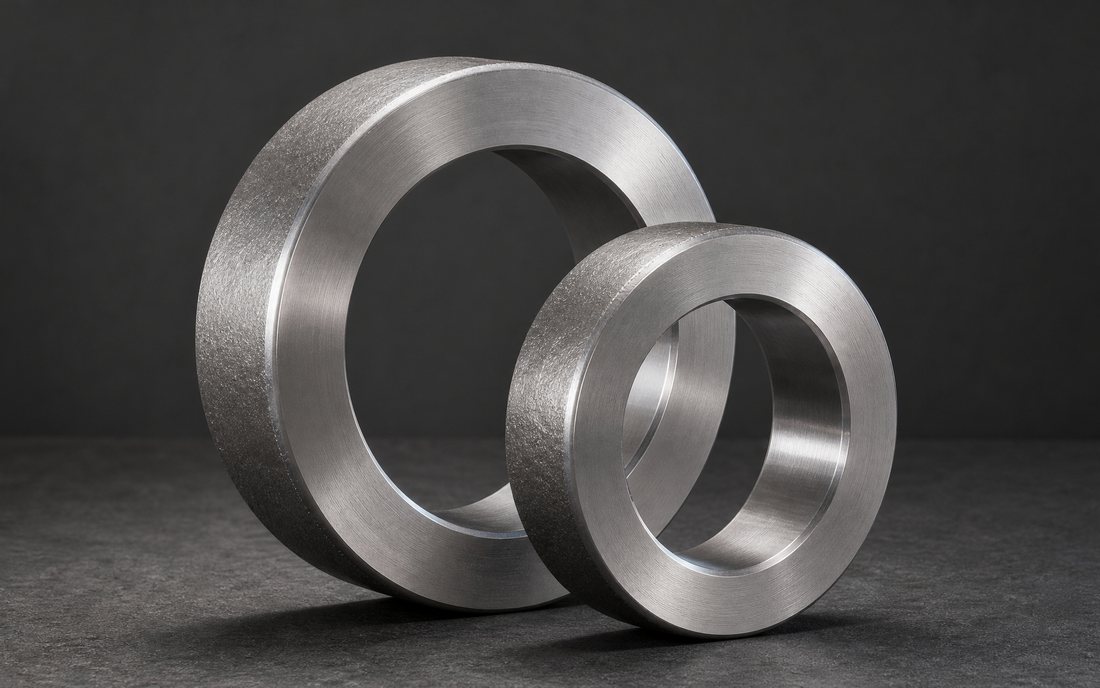
Buying Inconel 713C as remelt stock: the four things to put on the order
713C is a cast-only grade, supplied to AMS 5391 as remelt stock and cast bar, so the order line has to describe a casting input rather than a rolled bar. Four clauses — form, chemistry window, condition and acceptance document — decide whether the heat can actually be cast.
Most Inconel 713C enquiries are not about the alloy. They are about an order line written for a wrought grade — a diameter, a tolerance, a temper, a certificate — then copied across to a part that is cast. 713C is UNS N07713 and DIN 2.4671, supplied to AMS 5391 as remelt stock and cast bar for investment casters; it is not supplied as wrought bar, plate or tube. Four things on the order decide whether the heat you receive can actually be cast.
Why 713C cannot be ordered like a wrought grade
Aluminium at 5.50–6.50% and titanium at 0.50–1.00% generate a high volume fraction of gamma-prime Ni3Al, and that precipitate is where the grade gets its creep strength. The same addition takes away the ductility a rolling or forging schedule needs, so the alloy is melted and cast to shape instead of being worked. The grade is not forgeable and only poorly weldable.
There is a commercial consequence. Ask for round bar to AMS 5391 and the standard contradicts the form: AMS 5391 covers remelt stock and cast bar. The quotation then either stalls while somebody checks, or comes back as a product you did not ask for.
First: the form of supply, in your caster’s words
Remelt stock and cast bar are not interchangeable labels. Remelt stock is material your investment caster remelts to its own specification; cast bar is supplied as cast, for your own machining or for a caster that wants a defined input shape. Say which one the foundry wants and name the foundry specification if one exists. “Bar” alone leaves the mill guessing, and on a cast-only grade guessing is expensive in both directions.
Second: the chemistry window that changes the casting
Not every element is equally negotiable. Nickel runs 66.4–76.3% and chromium 12.0–14.0%; that chromium, with the aluminium, forms the alumina scale that carries the alloy to roughly 980 °C in oxidising service without a coating. Molybdenum sits at 3.80–5.20% and niobium at 1.80–2.80%. The elements that decide whether your caster has a good day are the minor ones: carbon 0.08–0.20%, zirconium 0.05–0.15% and boron 0.005–0.015%. On a cast grade those trace additions are not decoration; they influence grain structure and grain-boundary behaviour, and a range that looks wide on paper can be narrow in a running process.
| Property | Inconel 713C |
|---|---|
| UNS | N07713 |
| Europe | DIN 2.4671 |
| Delivery standard | AMS 5391 — remelt stock and cast bar |
| Nickel | 66.4 – 76.3% |
| Chromium | 12.0 – 14.0% |
| Molybdenum | 3.80 – 5.20% |
| Niobium | 1.80 – 2.80% |
| Aluminium | 5.50 – 6.50% |
| Titanium | 0.50 – 1.00% |
| Carbon | 0.08 – 0.20% |
| Zirconium | 0.05 – 0.15% |
| Boron | 0.005 – 0.015% |
| Iron | ≤ 2.50% |
| Silicon | ≤ 0.50% |
| Manganese | ≤ 0.25% |
| Density | 7.8 – 8.0 g/cm³ |
| Melting range | 1260 – 1290 °C |
| Service temperature | up to 982 °C |
Iron at ≤2.50% and manganese at ≤0.25% are tighter than the ceilings on most wrought nickel grades. If your foundry works to a narrower internal window on aluminium or boron than the table shows, put that window on the order rather than assuming the mill will infer it.
Third: condition, and what the test piece represents
The condition to write is as cast, or remelt stock to your foundry’s specification. There is no annealed or aged temper to call up on this grade, so a drawing that names one was written for a different alloy. The mechanical result follows the section it came from: state whether the test is cut from an integrally cast coupon or from the part, and at what thickness. With typical elongation of 3–8%, an acceptance figure borrowed from a wrought specification will reject castings that are perfectly sound.
Fourth: the acceptance document
Name AMS 5391 on the order and say what the certificate has to carry: heat chemistry, and mechanical results with the test location stated. A certificate that reports chemistry only is not enough for a casting that will be machined and put into a hot section, and one that reports mechanics without saying where the coupon came from cannot be compared with the next heat.
The order line, cast against wrought
The table below is the same order written twice. The right-hand column is what a cast-only grade needs.
| Order clause | Wrought bar order | 713C remelt stock order |
|---|---|---|
| Form | Round bar, plate or tube | Remelt stock or cast bar |
| Condition | Annealed, solution treated or aged | As cast, or to the foundry’s specification |
| Test location | Cut from the delivered bar | Integrally cast coupon or the part, section stated |
| Ductility limit | From the wrought product specification | Set against the 3 – 8% the cast route holds |
| Weld repair | Normally allowed under a qualified procedure | Only poorly weldable — permit or exclude it in writing |
| Standard cited | Bar standard | AMS 5391, remelt stock and cast bar |
What not to put on the order
- Bar tolerance callouts carried over from a wrought grade. There is no rolled section to hold them.
- An annealed or aged temper. The grade is supplied as cast, or as remelt stock to the foundry’s specification.
- An elongation figure with no coupon location behind it. The result follows the section, and the cast route holds 3–8% typically.
- Routine weld repair. The alloy is only poorly weldable, so repair is either agreed in writing or excluded.
- Grain-flow or directional-property acceptance. A casting has no grain flow to test.
What to send us
Send the casting drawing, the section thickness at the hottest point, the weight per piece and the number of pieces, and say whether you need remelt stock for your own caster or cast bar for your own machining. Name the foundry specification and the acceptance document, and include any internal aluminium or boron window your caster works to. Give the metal temperature at the part — average and peak, not the furnace setpoint — and state whether weld repair is permitted. With those facts we will check the chemistry against the heat certificate and quote on hangbonickel.com; the mailbox is vicky@hangboalloy.com.
Values quoted here follow the ASTM / EN edition named in each paragraph. For a specific heat, the governing numbers are those printed on the EN 10204 certificate that ships with the material. Written by the technical desk at Shanghai Hangbo Alloy Group.
Send the grade, the size, the quantity.
We will quote against your specification, including lead time, inspection level and documents.