
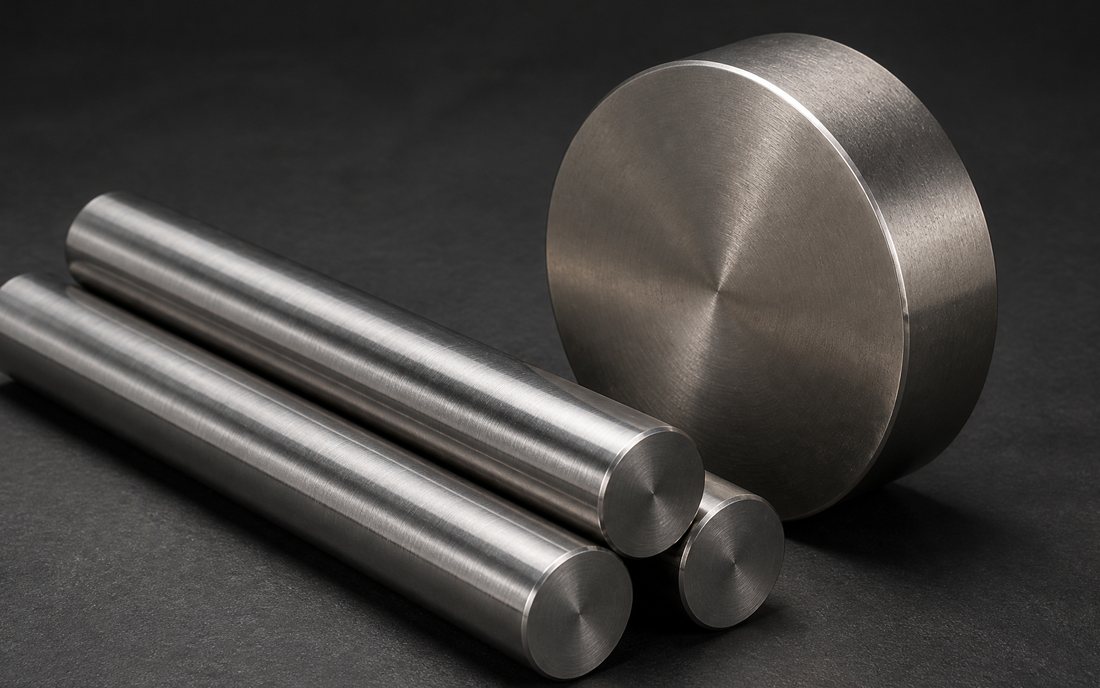
Nimonic 105
Wrought nickel-cobalt-chromium alloy strengthened with molybdenum, aluminium and titanium, developed for service up to 950 °C. Combines the strength of an age-hardening nickel alloy with good creep resistance for turbine blades, discs and ring sections.
- Europe
- NiCo20Cr15MoAlTi
- Density
- 8.01 g/cm³
- Melting range
- 1290 – 1345 °C
- Delivery
- Solution treated and aged; hardness reported per heat.
What the spec says
Chemical composition in weight per cent and the standards we routinely certify to. Governing values are those printed on the EN 10204 certificate for your heat.
| Element | % |
|---|---|
| Ni | Balance |
| Cr | 14.0 – 15.7 |
| Co | 18.0 – 22.0 |
| Mo | 4.5 – 5.5 |
| Al | 4.5 – 4.9 |
| Ti | 0.9 – 1.5 |
| C | ≤ 0.17 |
| Fe | ≤ 1.0 |
| Mn | ≤ 1.0 |
| Si | ≤ 1.0 |
| B | 0.003 – 0.010 |
| Zr | ≤ 0.15 |
| Cu | ≤ 0.20 |
| S | ≤ 0.010 |
| Form | Standard |
|---|---|
| Billets, bars, forgings | BS HR 3, AICMA Ni-P61-HT |
| Forged bar (DIN) | NiCo20Cr15MoAlTi |
| Extruded section | BS HR 3 |
Behaviour that matters in service
- Creep strength to 950 °C — Three-stage heat treatment gives the best long-term rupture and ductility at 850 – 950 °C.
- Age hardening — 1150 °C / AC + 1050 – 1065 °C / AC + 850 °C / AC for creep duty; a two-stage route is used where tensile and impact properties matter up to 700 °C.
- Oxidation — Weight loss stays low to 1000 °C; above 1050 °C the scale begins to spall.
- Machining — Hardness in the 320 – 385 HV range, so carbide tooling is required.
- Welding — Not recommended for fusion welding — microfissuring occurs in the weld and heat-affected zone. Flash-butt and brazing are used instead.
Typical applications
- Turbine blades — Blades and vanes for aero and industrial turbines.
- Discs and ring sections — Forged and extruded rotating parts.
- Bolts and fasteners — Hot-section fasteners from cold-worked bar.
How we ship Nimonic 105
Melted in our own furnaces, tested in our own laboratory, and released with a certificate that matches the stamping on the bar or plate.
Forms
Round bar from 6 mm, plate, strip, seamless tube, open-die forgings and drawn wire.
Condition
Solution treated and aged; hardness reported per heat.
Documents
EN 10204 3.1 or 3.2, with chemistry, mechanical results and heat number traceability.
Inspection
SGS, BV, Intertek or your own inspector — welcomed before shipment.
Send the grade, the size, the quantity.
We will quote Nimonic 105 against your specification — including lead time, inspection level and documents.